




Sildenafil dosage for ED depends on a person’s health, response to treatment, and risk of side effects. Sildenafil is commonly prescribed to manage erectile dysfunction (ED), which can affect a person’s ability to achieve or maintain an erection. For most adults, the standard starting sildenafil dosage for erectile dysfunction is 50 mg, taken when needed before sexual activity.
Depending on individual circumstances, a healthcare professional may prescribe 25 mg or 100 mg instead. Understanding the recommended sildenafil dose, timing, and safety precautions can help you use the medication responsibly.
What is the Recommended Sildenafil Dosage for Erectile Dysfunction?
The usual sildenafil dosage for adults with erectile dysfunction is 50 mg as needed, although the appropriate dose varies from person to person.
What is the Usual Starting Dose of Sildenafil for ED (Erectile Dysfunction)?
For most adults with ED, treatment typically begins with sildenafil 50 mg before sexual activity. Depending on a person’s medical history, current medications, and potential risk of side effects, a healthcare professional may recommend a 25 mg starting dose instead.
The prescribed amount may be reviewed based on treatment results and tolerability. Always consult your healthcare professional before changing your sildenafil dosage.
How to Choose the Right Sildenafil Dosage?
Choosing the right sildenafil dosage for ED depends on your health, treatment goals, other medications, and how well you tolerate the medicine. A healthcare professional can help determine whether 25 mg, 50 mg, or 100 mg is appropriate for your individual needs.
Several treatments are available for erectile dysfunction, and the most suitable option depends on a person’s health status, medical history, and treatment needs. Explore our guide to erection problem medication to understand available treatments, how they work, and important safety considerations.
Consider these important factors when discussing the right sildenafil dose for erectile dysfunction:
- Starting dose: For most adults, 50 mg is the usual recommended starting dose. A clinician may prescribe 25 mg when a lower dose is more appropriate.
- Effectiveness: Your healthcare professional may review whether the prescribed dose helps you achieve and maintain an erection during sexual stimulation.
- Side effects: Headache, flushing, indigestion, and dizziness may affect which dose is suitable for you.
- Existing health conditions: Kidney or liver impairment, cardiovascular conditions, and blood pressure problems can influence prescribing decisions.
- Medication interactions: Nitrates, alpha-blockers, and certain other medicines can affect sildenafil’s safety or dosing.
- Treatment response: If the medication does not work as expected, your clinician can review the timing, food intake, and other possible factors before considering any adjustment.
Recommended Sildenafil Doses for Adults: 25 mg, 50 mg, and 100 mg
The commonly prescribed sildenafil dosage for adults with ED includes three tablet strengths:
- Sildenafil 25 mg: A lower dose that may suit certain patients who need a more cautious starting dose.
- Sildenafil 50 mg: The usual recommended starting dose for most adults.
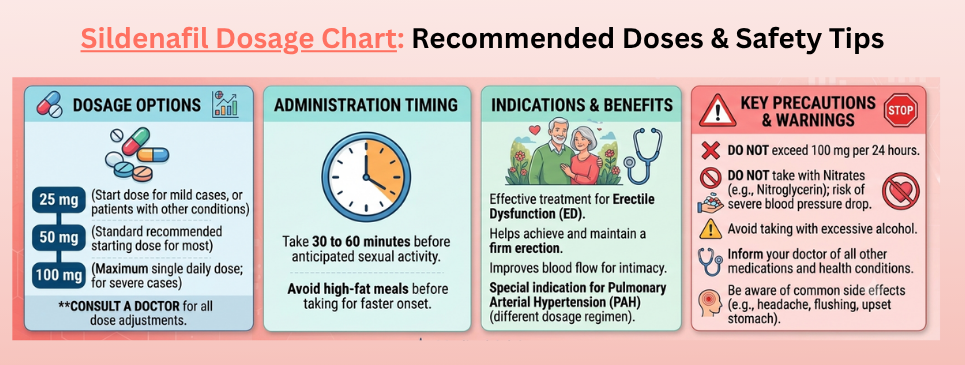
- Sildenafil 100 mg: The maximum recommended single dose for ED when a clinician determines that a higher dose is appropriate.
Taking a higher dose does not necessarily improve results and may increase the likelihood of sildenafil side effects.
Sildenafil is the active ingredient in Viagra, and both contain the same medication when the products are equivalent in strength and formulation. Read our detailed comparison of sildenafil vs. viagra to understand their similarities, differences, and key considerations when choosing an ED treatment.
Important: Do not select a dose, increase your dosage, or take an additional tablet without medical guidance. Sildenafil must not be combined with nitrate medications or recreational nitrites (poppers), as this can cause a dangerous drop in blood pressure.
How Is Sildenafil Dosage Determined?
Healthcare professionals consider several factors when selecting the appropriate sildenafil dose for erectile dysfunction, including:
- The severity and frequency of erection difficulties.
- Previous response to ED treatment.
- Kidney and liver function.
- Cardiovascular health and blood pressure.
- Other medications and potential drug interactions.
- Previous side effects or sensitivity to sildenafil.
The correct sildenafil dosage for ED is the dose prescribed for your individual circumstances, not necessarily the highest available strength.
Sildenafil Dosage Chart: Recommended Doses at a Glance
The following sildenafil dosage chart summarizes common prescribing approaches. These are general reference points, not personalized treatment instructions.
| Treatment or dosage context | Typical prescribed dose or dosing approach | Important considerations |
|---|---|---|
| ED – usual starting dose | 50 mg as needed | Taken approximately one hour before sex |
| ED – lower dose | 25 mg as needed | May be appropriate for certain patients |
| ED – higher dose | 100 mg as needed | Maximum recommended ED dose for most adults |
| ED – dosing frequency | No more than once per 24 hours | Follow the prescribed frequency |
| Pulmonary arterial hypertension (PAH) – adults | Commonly 20 mg three times daily | Separate treatment regimen requiring medical supervision |
The sildenafil dosage for pulmonary hypertension follows a different treatment schedule from the one used for erectile dysfunction. These two regimens should not be interchanged.
Never use an ED dosing chart to adjust treatment for pulmonary arterial hypertension.
How to Take Sildenafil: Timing, Food, and Effectiveness
Understanding how to take sildenafil for erectile dysfunction correctly can help you follow your treatment plan. The medication is taken orally with water, according to your prescription.
When Should You Take Sildenafil Before Sexual Activity?
For erectile dysfunction, sildenafil is usually taken about one hour before sexual activity. Official prescribing information allows a window of approximately 30 minutes to four hours before sex, depending on individual circumstances.
The time sildenafil takes to work varies between individuals. Do not take an extra tablet simply because the medication has not worked as quickly as expected.
Should Sildenafil Be Taken With Food or on an Empty Stomach?
Sildenafil can be taken either with food or on an empty stomach. However, eating a high-fat meal beforehand can slow its absorption and delay the onset of its effects. Follow your healthcare professional’s instructions about meals and administration.
Does Sildenafil Work Without Sexual Stimulation?
No. Sildenafil does not automatically cause an erection and does not directly increase sexual desire. Sexual stimulation is required for sildenafil to help produce an erection; taking the medicine alone does not automatically trigger one.
Visual examples and realistic expectations can help readers better understand ED treatment outcomes. Explore our viagra before and after photos guide for more information about treatment results and individual differences.
The effectiveness of ED treatment may differ based on a person’s health, the cause of erectile dysfunction, and how their body responds to the medicine.
Sildenafil Dosage for First Time: What Should You Know?
For someone taking sildenafil for the first time, 50 mg is the usual starting dose for ED, but a clinician may prescribe 25 mg or another appropriate dose based on individual circumstances.
Before starting treatment:
- Provide your healthcare professional with a complete list of prescription medicines, nonprescription products, and supplements you use.
- Discuss any existing heart conditions, blood pressure concerns, or kidney and liver problems.
- Follow the prescribed sildenafil dose and timing.
- Do not combine sildenafil with another ED medication unless specifically directed by your clinician.
- Never increase your dose or take another tablet early because the first dose seemed ineffective.
If sildenafil does not work the first time, consult your healthcare professional before making any changes.
Sildenafil Dosage by Age: Does Age Matter?
Sildenafil dosage by age depends on individual health factors and is not based on age alone. A healthcare professional also considers overall health, organ function, current medications, and the likelihood of side effects.
Age can influence erectile function, but ED is not an inevitable part of getting older. Read our guide to erectile dysfunction age to learn about age-related factors, common causes, and available treatment options.
Sildenafil Dosage for Older Adults:
Older adults may process sildenafil differently because of age-related changes in the body. The prescribing information advises considering a 25 mg starting dose of sildenafil for older adults, particularly when other risk factors are present. The appropriate dose should be selected by a qualified healthcare professional after reviewing individual risk factors.
When Might a Lower Dose Be Needed?
Some people may need a lower sildenafil dosage to reduce the risk of side effects. A healthcare professional may recommend a smaller dose in the following situations:
- Kidney problems: Reduced kidney function may affect how the body processes sildenafil.
- Liver problems: Liver conditions can slow down the breakdown of the medicine.
- Other medications: Certain medicines can increase sildenafil levels in the body and raise the risk of side effects.
- Alpha-blockers: These medicines, often used for high blood pressure or prostate problems, may increase the risk of low blood pressure when taken with sildenafil.
- Previous side effects: People who experience troublesome side effects may need their dose reviewed by a healthcare professional.
The right sildenafil dosage by age depends on more than age alone. Your overall health, existing medical conditions, and other medicines also help determine which dose is appropriate. Always consult your healthcare professional before changing your dose.
What Is the Maximum Dose of Sildenafil?
For most adults with ED, the maximum recommended sildenafil dose is 100 mg in a 24-hour period.
The standard starting dose of sildenafil for ED is usually 50 mg, taken when needed before sexual activity. Depending on the person’s response and tolerability, a clinician may prescribe 25 mg or 100 mg.
Although people often search for “what is the maximum dose of sildenafil,” the highest recommended dose is not necessarily the safest or most effective choice for everyone. Taking more than prescribed can increase the risk of side effects, including dizziness, low blood pressure, and visual disturbances.
Sildenafil Daily Dosage: Can You Take It Every Day?
Sildenafil daily dosage for ED is generally not a scheduled daily regimen; the medication is usually taken as needed. Taking sildenafil more than once in a 24-hour period for ED is not recommended.
Sildenafil may be used regularly when prescribed, but each dose must follow the recommended frequency. People who need frequent ED treatment can discuss other suitable options with their healthcare professional.
Daily tadalafil is a different treatment option for some people and should not be confused with a daily sildenafil regimen.
Important: Sildenafil for pulmonary arterial hypertension is commonly prescribed three times daily under specialist supervision. This regimen is different from ED dosing and must not be used as a guide for treating erectile dysfunction.
Sildenafil Dosage for Pulmonary Hypertension
Sildenafil dosage for pulmonary hypertension is different from ED dosing. Sildenafil may be prescribed for pulmonary arterial hypertension (PAH), a condition in which blood pressure is elevated in the arteries carrying blood from the heart to the lungs.
For adults with PAH, the usual oral Revatio regimen is 20 mg three times daily. The prescribed PAH regimen should be followed exactly as directed by the treating specialist, who can determine whether any adjustment is appropriate.
Is Sildenafil Dosage Based on Weight?
Sildenafil dose per kg is not a universal dosing method for adults receiving ED treatment. Weight can be relevant in certain pediatric PAH treatment regimens, but dosing must follow the relevant prescribing information.
For example, the US Revatio prescribing information specifies oral doses of 10 mg three times daily for children weighing 20 kg or less and 20 mg three times daily for children above 20 kg, with additional prescribing considerations for heavier children.
These are condition-specific pediatric regimens, not general dosing instructions. A pediatric specialist must determine the appropriate dose.
Sildenafil Side Effects, Interactions, and Safety Precautions
Although many patients tolerate sildenafil, sildenafil side effects and drug interactions can occur. Understanding possible adverse effects and medication interactions is essential before starting sildenafil.
Common Side Effects of Sildenafil
Common side effects of sildenafil for ED include headache, facial flushing, indigestion, nasal congestion, and dizziness.
- Headache.
- Facial flushing.
- Indigestion.
- Nasal congestion.
- Dizziness.
- Nausea.
- Temporary changes in vision, such as blurred vision or a blue tinge.
Seek medical advice if side effects are persistent, severe, or troublesome.
Who Should Avoid Sildenafil?
Sildenafil must not be combined with nitrate medications or recreational nitrites known as poppers because the combination can cause a dangerous drop in blood pressure.
Nitrates include medicines such as nitroglycerin and isosorbide used for chest pain. Sildenafil is also contraindicated with riociguat, a medication used for certain forms of pulmonary hypertension.
Before treatment, discuss heart disease, low blood pressure, alpha-blockers, other blood pressure medicines, and all other medications with your clinician.
What is the recommended sildenafil dosage for adults with ED?
+
For most adults with erectile dysfunction, the typical starting dose is 50 mg of sildenafil, taken when needed before sexual activity. Depending on a person’s health, other medicines, and response to treatment, a healthcare professional may recommend 25 mg or 100 mg instead.
Which sildenafil dose works best for Erectile Dysfunction?
+
The appropriate sildenafil dosage for erectile dysfunction varies from person to person. Many adults begin with 50 mg, but some may need a lower or higher prescribed dose. Never take more than your recommended dose or exceed 100 mg within 24 hours.
Is sildenafil 100 mg suitable for first-time use?
+
Taking sildenafil 100 mg for the first time may not be suitable for everyone. The usual starting dose for ED is 50 mg, although a doctor may suggest 25 mg based on your health or possible medicine interactions. Always seek medical advice before starting with a higher dose.
How many times can you take sildenafil in 24 hours?
+
For erectile dysfunction, sildenafil is generally taken once within a 24-hour period. Follow your prescription carefully, and do not take another tablet simply because the first dose did not work as expected. If you have concerns about the results, consult your healthcare professional.
Does body weight affect sildenafil dosage?
+
For most adults receiving sildenafil treatment for ED, the dose is not routinely calculated according to body weight. However, sildenafil dosage by weight may be important for certain children being treated for pulmonary hypertension. These cases require dosing and monitoring by a specialist.
What can you do if sildenafil does not work?
+
If sildenafil does not give you the expected results, do not increase the dose on your own. Consult a healthcare professional to discuss the timing of your dose, food intake, other medications you take, and potential causes of erectile dysfunction. This can help identify the right treatment approach for your needs.